
Redefining wages, and what it means for gratuity, benefits and employer cost
A year ago, we wrote about what the new labour codes would mean for employee benefits in India. The FY 2025-26 books are now closed, and the effect is no longer theoretical — here it is, in the numbers.
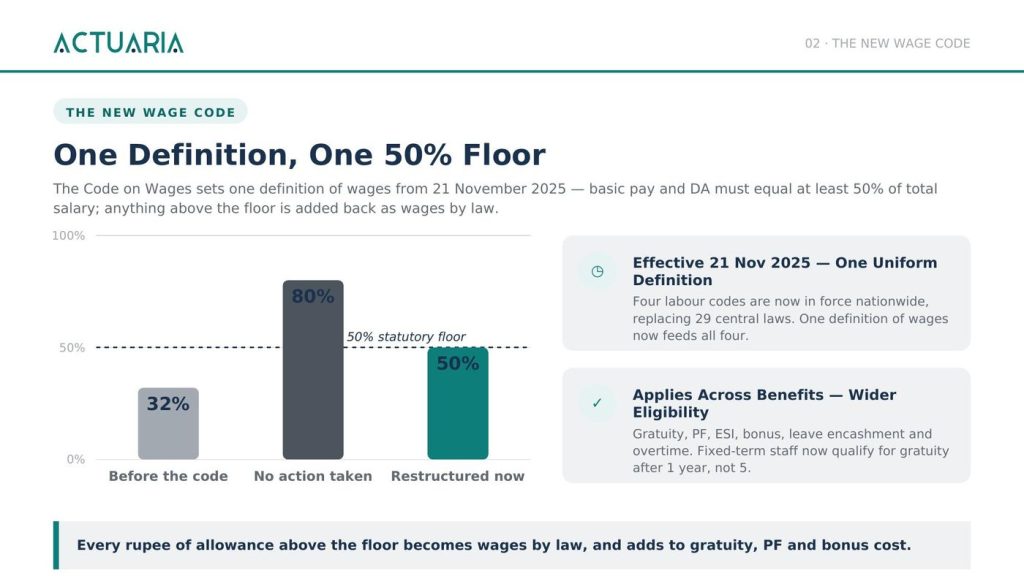
The Code on Wages sets a single wage definition from 21 November 2025: basic pay and DA must equal at least 50% of total salary, or the shortfall is added back by law. It applies across gratuity, PF, ESI, bonus, leave encashment and overtime — and fixed-term employees now qualify for gratuity after 1 year, not 5.
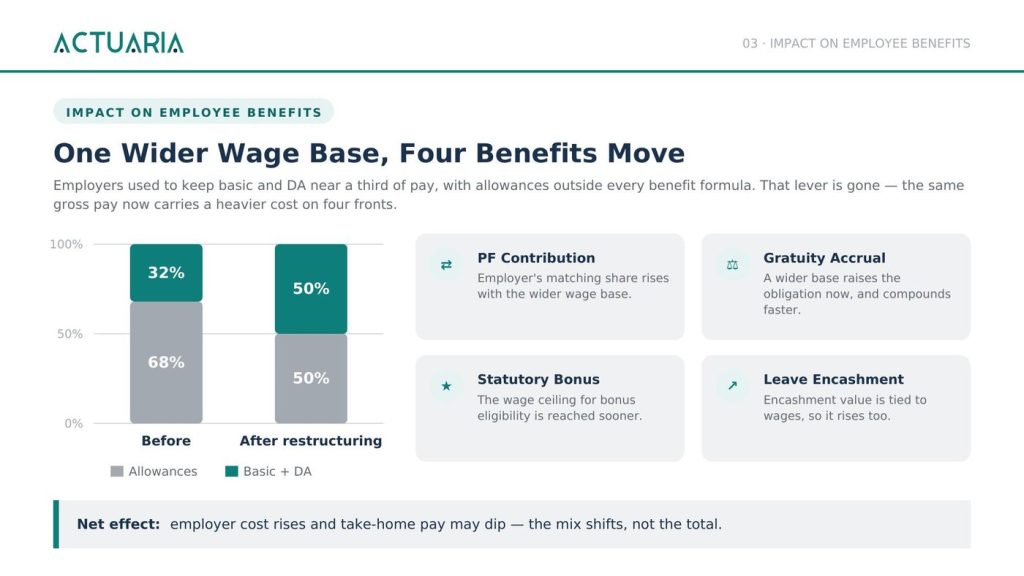
Same gross pay, different mix: PF contribution, gratuity accrual, statutory bonus and leave encashment all move together once basic + DA shifts from roughly a third of salary to half.
How the past service cost hit the books
Gratuity is valued on last-drawn wages, so the wider base lifted the value already earned for past service — booked immediately as past service cost (PSC). Ind AS 19 filers took it fully in the P&L this year; AS 15 filers amortise the unvested portion. (See our AS 15 vs Ind AS 19 guide for the mechanics.)
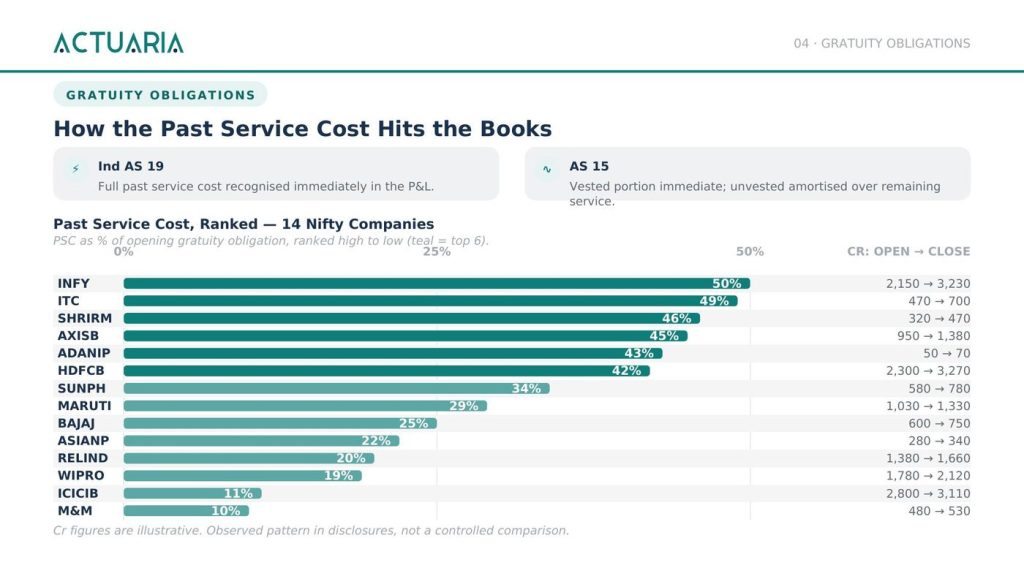
Across 14 Nifty companies, PSC ranged from 10% to 50% of the opening obligation — IT services and BFSI names (Infosys, ITC, Axis Bank, HDFC Bank) at the high end, reflecting historically allowance-heavy pay structures; ICICI Bank and M&M at the low end.
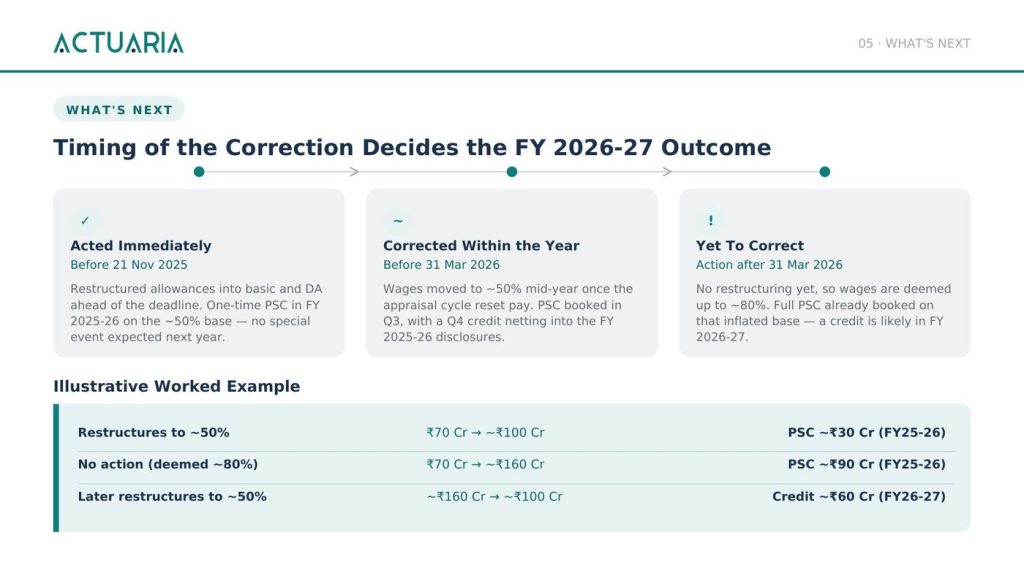
The takeaway: for any employer that hasn’t yet corrected its pay structure, this is a two-year accounting event, not a one-time one. Companies still running an inflated ~80% wage base booked an overstated PSC in FY 2025-26 — and should expect a partial credit back in FY 2026-27 once they restructure.
What this means for employers and actuaries
- Real disclosures now confirm the wage-base widening: PSC ranged 10%–50% of opening obligation across the 14 names reviewed.
- Employers who restructured ahead of 21 Nov 2025 booked a smaller, one-time cost; those who didn’t should model a partial reversal in FY 2026-27.
- Review payroll wage-mapping and actuarial assumptions now, and update FY 2026-27 provisioning notes to anticipate the reversal.
This summary is for informational purposes only. Please refer to the officially notified text of the Code on Wages, 2019, the Code on Social Security, 2020, and related rules, and seek actuarial or legal advice before acting on any figures above.
Related reading: What the New Labour Codes Mean for Employee Benefits in India · Gratuity Plan Accounting: A Practical Guide to AS 15 and Ind AS 19
Get in touch with Actuaria — think of new age actuaries, think of Actuaria.